Dec 7, 2009
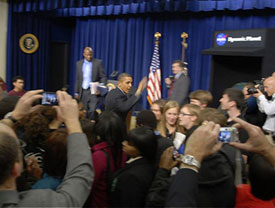
On November 23, 2009, NASA's Science Mission Directorate, supported by SESDA II staff members, participated in the launch of President Obama's "Educate to Innovate" Campaign for Excellence in Science, Technology, Engineering & Math (STEM) Education. The event was held in the South Court Auditorium at the Dwight D. Eisenhower Executive Office Building. Our staff provided the Dynamic Planet digital video globe as an example of an interactive learning tool for students of all ages. The system was on stage with the President as he made his remarks. "I want to thank NASA and Charlie (Bolden) for providing the interactive globe — an innovative and engaging way of teaching young people about our world." The full text of the President's remarks can be found at the following link:
View the President's remarks.
Following the event, the students in attendance were able to briefly interact with the Dynamic Planet.
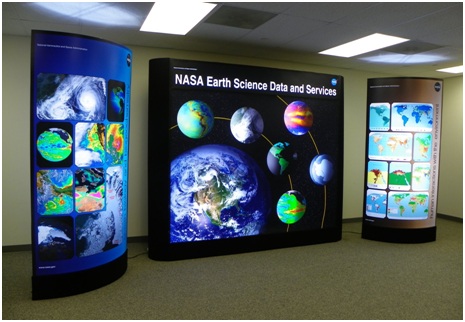 SESDA outreach staff procured and created cross-platform, data imagery content for a brand new backlit exhibit booth. This new booth will make its debut during the upcoming Ecological Society of America (ESA) Annual meeting to be held in Pittsburgh, PA August 1-6, 2010.
 A SESDA team member, Kathryn Hansen, went to sea for three weeks off the north coast of Alaska, on NASA's ICESCAPE oceanographic mission, shooting photographs and video. Images taken have been added to a NASA Flickr set, with hundreds more set to be archived for future usage. The film footage will be used for a post-cruise web short video. http://www.flickr.com/photos/nasahqphoto/sets/72157624451054154/
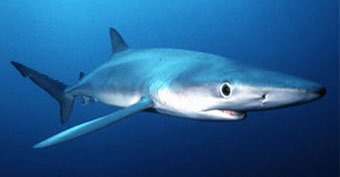
A study to be published in the 15 January 2010 issue of Fisheries Research describes characterization of an oceanic region in the southwest Atlantic Ocean, near the coast of southern Brazil, where juvenile blue sharks (Prionace glauca) are found in high numbers. One of the unusual aspects of the region is that mature blues are not found in the region.
The research paper authored by Santiago Montealegre-Quijano and Carolus M. Vooren of the Universidade Federal do Rio Grande (FURG) Instituto de Oceanografia, Laboratório de Elasmobrânquios e Aves Marinhas, utilized data from commercial fishing operations. The researchers determined that juvenile blue sharks stay in the region until they are about 1.3 meters in length. Then, the juvenile sharks disperse, with the young male sharks heading north, and the young female sharks heading south, south of the Subtropical Convergence Zone, waiting to head north until late austral summer.
Sea surface temperatures from MODIS, analyzed with Giovanni, a data exploration analysis and visualization tool developed in part by a collaborative effort involving SESDA II scientists and engineers were used to characterize the location of the Subtropical Convergence Zone during the study period. These data helped to determine the location of the convergence zone during the periods when the fishing stations were observed. According to the authors, the Subtropical Convergence Zone occurred in the study area from late autumn into spring. The study describes possible migration routes of pregnant female blue sharks through the southwest Atlantic and how they return to the nursery zone to give birth to baby blue sharks.
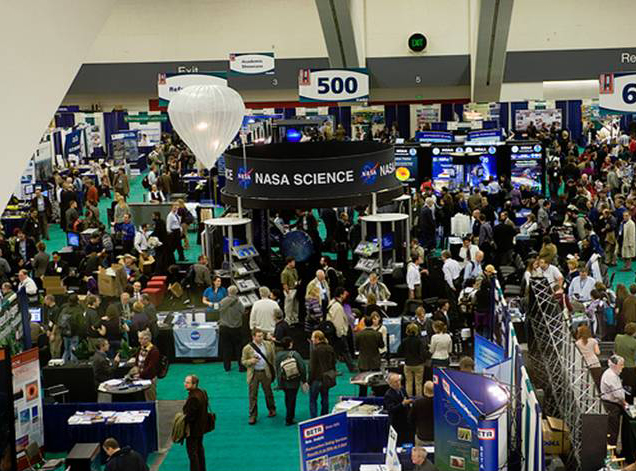
SESDA II staff members planned and implemented the NASA booth at the Fall American Geophysical meeting in San Francisco. More than 10,000 people viewed booth exhibits and events, including the ‘Dynamic Planet’; an 81” video board showing continuous clips of NASA Science research and results; plus talks by prominent scientists. The SESDA team was led by Jennifer Brennan and Winnie Humberson.
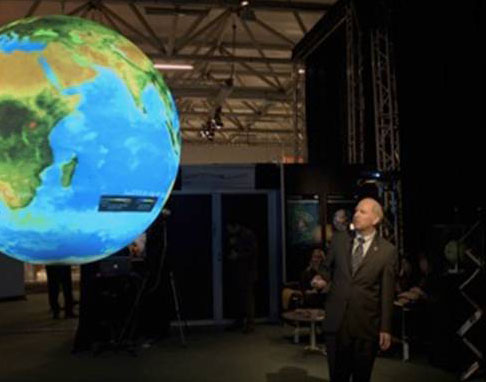
SESDA II staff member, Maurice Henderson, attended and supported the Science on a Sphere exhibit at the 15th Conference of the Parties Surroundings Change conference in Copenhagen, Denmark, in December. Several surroundings scientists presented data using the Sphere. The figure shows Dr. Alexander MacDonald, National Oceanic and Atmospheric Administration’s (NOAA) Office of Oceanic and Atmospheric Research Deputy Assistant Administrator for Labs and Cooperative Institutes, presenting data which was simulcast to other Spheres around the world. Mr. Henderson is the principle developer of the exhibit.
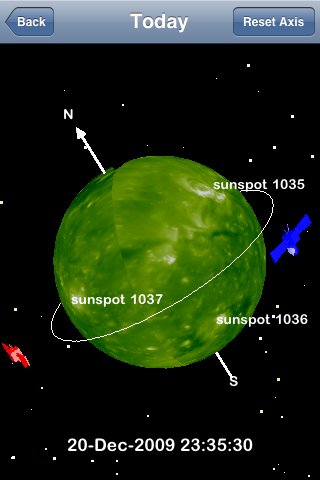
Dr. Tony Phillips, currently a consultant working with SESDA II staff, has developed a novel freeware application for the Apple iPhone and iPod Touch that uses real-time observations from the twin STEREO spacecraft to give a 3-D view of the state of the Sun. Views from both the STEREO Ahead and Behind spacecraft are blended together onto a spherical representation of the Sun.
Users can rotate the Sun to see active regions and sunspots both on the Earth-facing side, and on the far side to see what active regions might be coming around in the next few days. If you worry about when that next big Solar flare is going to affect your GPS system or satellite TV, then this is the app for you. The app is now available for download at appshopper.com/education/3d-sun.
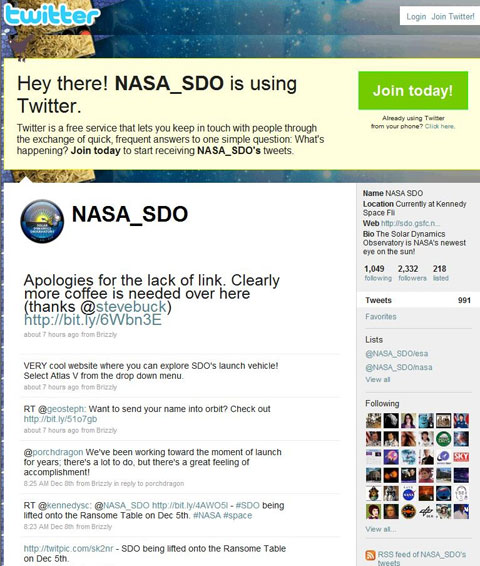
With SDO launch looming in early 2010, SESDA II Education and Public Outreach (EPO) staff are planning the first ever launch Tweetup (http://twitter.com/NASA_SDO) where people who twitter can come together to meet in person at the Kennedy Space Center (KSC). Twitter has become the preeminent tool for providing timely information to the general public on SDO’s launch schedule and associated events planned at KSC and Goddard Space Flight Center. The SDO Twitter account currently has 2,200 followers reaching up to 28,000 unique users, and is ranked the 11th most popular NASA-related Twitter account.
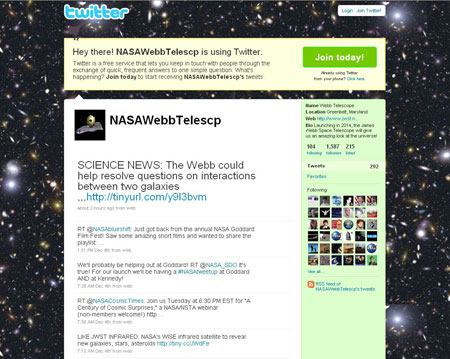
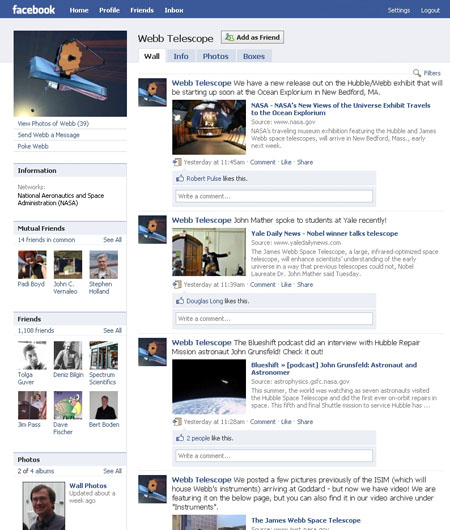
If you’re like most people you keep in touch with your social network via Facebook. Well, now you can make a new friend: the James Webb Space Telescope! A SESDA II staff member who participates in Education and Public Outreach for the JWST project started this page as a way to keep the public interested and informed about the telescope, which is currently scheduled for launch in 2014. The JWST Facebook page is updated regularly with news notes, photos, and videos and currently boasts more than 1250 friends!
You can also join the more than 1450 people who follow JWST on Twitter at twitter.com/NASAWebbTelescp or check out the project’s YouTube channel (another SESDA II innovation).
The combination of Giovanni and Google Earth allows striking visualization of data from the “A-Train” satellite constellation. SESDA II staff helped develop the Giovanni Google Earth visualization capability which uses the A-Train constellation data to provide users with ability to visualize both vertical data curtain plots and surface strips for the same temporal and spatial range. Researchers can now select a specific temporal/spatial range to obtain KMZ files (Google Earth native formats) with vertical information (temperature, water vapor, clouds, aerosols, etc.) and surface swaths (cloud pressure, cloud top temperature, cloud cover, etc.) which can be subsequently downloaded and viewed in a Google Earth browser.
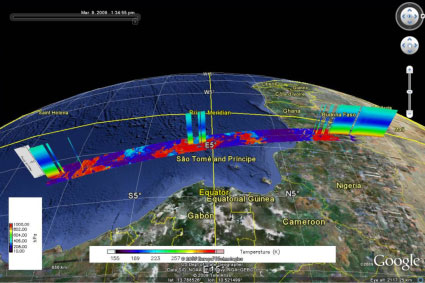
This image shows a visualization of the Atmospheric Temperature Vertical Profile and Cloud Top Pressure Surface Strips from MODIS-Aqua on March 9th, 2009 over the regions in the equatorial Africa. Note that the image is oriented with North to the right.